A wedding time capsule: the picture that only appears on your anniversary
Most wedding time capsules collect what already exists on the day: letters, cards, a photo. There is one form where the capsule is the picture itself, and nobody has seen it yet.
September 10, 2026 · 13 min read · Przemek Zajfert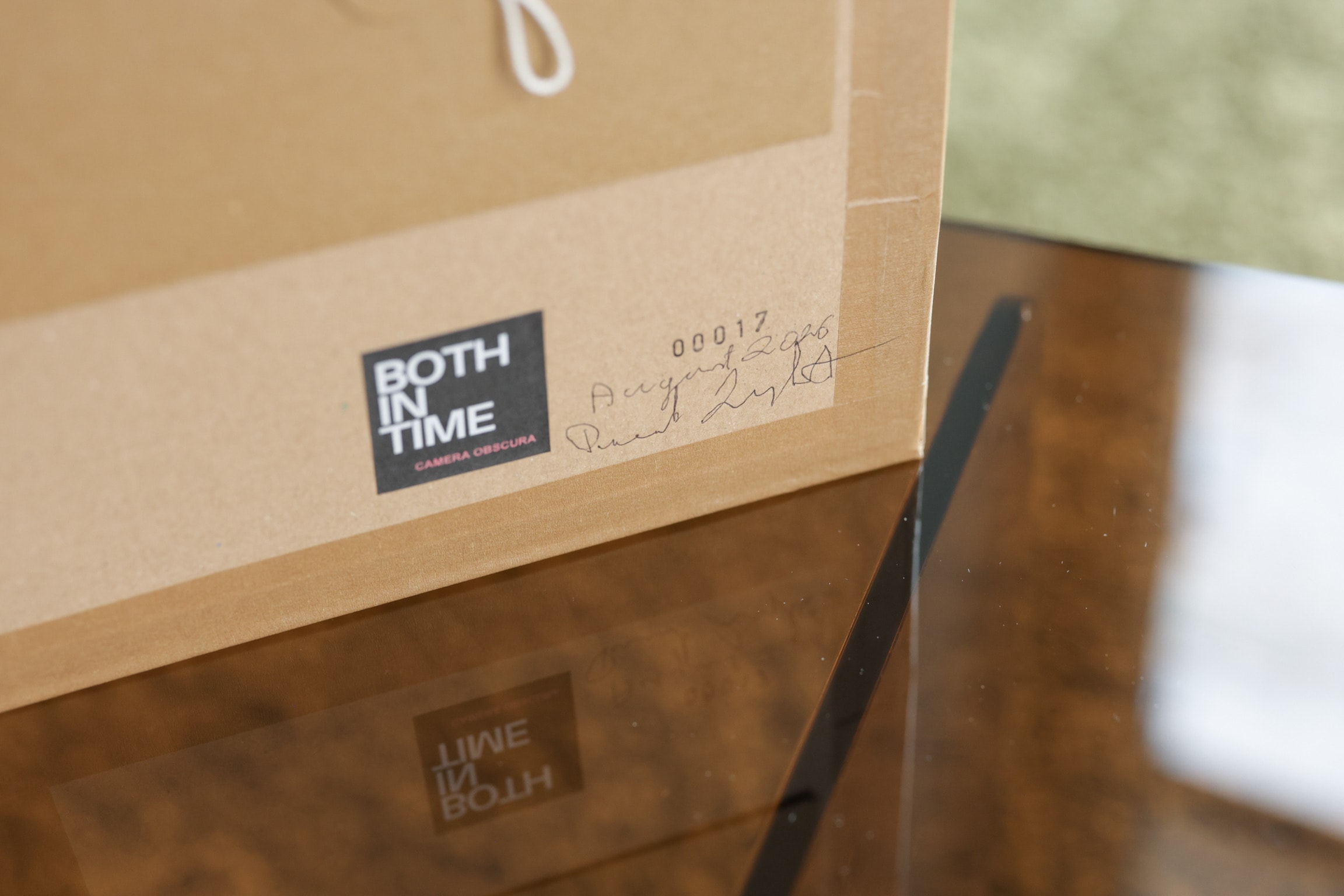
A wedding makes more pictures in one day than the rest of the year puts together. Two phones per table, a reportage photographer, plus whichever camera somebody fetched from the car. A year later almost nobody remembers a single one of those photos. Everyone remembers the evening as a whole, and the files sit in a folder no one opens.
That is why so many couples end up at the idea of a time capsule. Not more pictures, but a container, a date, and an agreement not to look inside until then. This piece answers, in order, what belongs in one, which forms exist, what they cost, when to open it, and where each of them runs out. Then it describes a form that works the other way round: a capsule whose contents do not yet exist on the wedding day.
A wedding time capsule, rethought
The usual time capsule preserves. You put in what is already there on the day, close it, and wait. That works, and how to do it well is further down. But it has a disappointment built into it: when you open it, you find exactly what you put in. The only surprise is how foreign your own handwriting has become.
There is a second option, and it is the real subject of this piece. Instead of putting a finished picture into the capsule, you make the picture the capsule. A sheet of photographic paper is half exposed on the wedding day. Then the camera is taped shut, dated, signed, and never opened again. What stays behind on the paper is an invisible trace of the day, a latent image nobody can look at without destroying it.
That is a time capsule in the literal sense: sealed, dated, irreversible. Except that when you open it you do not see what you put in. You see, for the first time, what fell onto the paper on your wedding day through a hole 0,3 mm wide. The second half of the sheet is exposed on your anniversary, and only then does it go into the developer. Two days are involved in the result, years apart, on a single sheet.
What is a wedding time capsule?
A wedding time capsule is a sealed container holding things from the wedding day, with a fixed date on which you open it, typically the 5th or the 10th anniversary. Both In Time turns it into a pinhole camera whose picture is half exposed on the wedding day and only finished on the anniversary.
A time capsule has three parts, and only one of them is the container.
The first part is the contents: objects, texts and pictures meant to hold one particular day. The second is the date it gets opened. The third is the agreement about who may open it and who keeps their hands off until then.
The container is interchangeable. A biscuit tin works, a wooden box works, a screwed steel capsule works. What makes a capsule fail is almost never the material. It is the missing date. A box labelled "open sometime" never gets opened, because there is no day on which it falls due. Put "not before 12 July 2036" on it and it does get opened, because that day eventually lands in a calendar and somebody remembers.
A second, unromantic point about the container: where it lives. Burying it photographs beautifully during the ceremony and is the most common way to lose a capsule. Soil means moisture, moisture means mould, and one winter is enough to turn letters and photographs into pulp. Dry, dark and indoors is duller and it works. A shelf, a cupboard, the attic if you must, as long as it is not a place you would leave behind in a move.
At a wedding, one part comes for free. The anniversary is a date that returns every year anyway, and all you have to decide is which one. Wedding capsules therefore get opened more often than the box somebody carried into the cellar on moving day.
The usual wedding time capsule ideas, and where each one stops
Four forms turn up almost everywhere, and all four are defensible.
The wine box. One bottle, two glasses, a letter from each of you to the other, all of it in a wooden box, often nailed shut during the ceremony itself. The best ceremony of the four, because the nailing happens in front of everyone. Where it stops: wine is perishable. A bottle that spends ten years next to a radiator is vinegar by the anniversary, and the box turns into furniture that slides further back with every move.
The metal capsule. Screwed shut, often engraved, sold to be buried. It keeps water out better than cardboard and is otherwise the same box, heavier. Anyone who actually buries it is likely to lose it: gardens get sold, trees come down, and nobody remembers the distance from the fence.
The card set for guests. Eighty small cards written on during the evening, each marked with a year. As an alternative to a guest book this works well. As a time capsule it works less well: what you hold in ten years is eighty polite formulas from people who had three minutes between courses.
The memory box. Menu card, buttonhole, photographs, tickets, everything left on the tables at the end of the night. The most honest form, because it takes the day as it was.
All four share the same limit. They preserve what already exists on the wedding day, and some of it survives storage badly. Inkjet prints fade, till receipts go blank within a few years, and paper in wet soil is pulp after one winter. The real wear, though, is a different one. The capsule sits on the shelf, the opening slides to a weekend when everybody has time, and that weekend does not come.
What to put in a wedding time capsule, and what happens when the picture is the capsule
First the useful answer to the question as it is actually asked. Take what carries the day, not what is valuable:
- A handwritten letter from each of you to the other, sealed and unread.
- The menu card with the scribbles from the evening on it.
- The sheet your best woman read her speech from.
- A photo on paper, not on a memory stick. A storage device from today is a piece of plastic without a reader in ten years.
- The playlist, printed, with the song marked that got everyone off their chairs.
- Something embarrassingly specific: the receipt from the night before, the price of petrol, the phrase the two of you keep saying this week.
- One line on every piece explaining why it is in there. None of it explains itself a decade later.
Put that together and you have a good capsule. You also have a collection of things that were all finished on the same day.
This is exactly where the other form starts. There is precisely one thing you cannot pack on your wedding day, because it does not exist yet: a picture from the future. A picture you begin on the wedding day and finish on a day that has not happened. No container can hold that. An undeveloped negative can.
The camera as the capsule: one negative, half exposed on the wedding day, developed years later
Both In Time is an analogue pinhole camera made of cardboard, built in Stuttgart by Przemek Zajfert and numbered in sequence. Zajfert is a photographer and light artist, in Stuttgart since 1985, working with camera obscura and long exposures; the double-pinhole idea comes out of a 1999 work, made because two artists wanted one shared picture and lived too far apart to take it. The camera has no lens, no viewfinder and no settings. It has a hole 0,3 mm across and a flap in front of it. Inside lies a single sheet of photographic paper in A5, and that sheet is meant for exactly one picture in two halves. There is no second sheet.
Before the ceremony, the first half is exposed. Flap open, the light of the day falls through the hole for minutes, flap closed. Who presses is up to you: the two of you, your witnesses, your parents. The camera is then closed with a strip of tape and the seal sticker, the date goes next to it in pencil, along with a signature and the stamped number that exists only once. From that moment the camera is a time capsule in the strictest sense: opening it erases the contents. Light here is not looking, it is deleting.
Then it stands on a shelf, not as a keepsake but as an open account. A trace of your wedding day lies on that paper, and nobody in the world knows what it shows, yourselves included.
On the anniversary, the second half is exposed, and only then does the sheet meet daylight for the first and only time, in your own kitchen. Step three on our wedding page puts it in one sentence:
An image that waited until you were ready to see it.
In full, on Both In Time for weddings: "Ten years later, on the anniversary: expose the second half, then develop for five minutes in the darkened kitchen under red light with instant coffee, vitamin C, and baking soda. An image that waited until you were ready to see it."
The developer really is coffee. Instant coffee, vitamin C and baking soda together make a developer you could in theory drink, and it needs no laboratory, just a darkened kitchen, a red lamp and a tray. After roughly five minutes the negative comes out of the liquid, wet and reversed. You photograph it and turn it into a positive with the tool on the site. That is the moment two exposures years apart are seen as one picture for the first time.
What such a picture shows is unlike anything else made that day. A pinhole camera needs minutes, not fractions of a second. Anyone who moves disappears or turns into a streak; anyone who stands still stands sharp. The room you married in stays in either case. That is not a weakness of the process: it is what a photograph looks like when it shows how long a moment lasted. And because both halves sit on the same sheet, the wedding day and the anniversary end up next to each other in one image, with no montage involved.
The camera costs 79 euros including VAT. What you are buying is strictly speaking not an object but an appointment with a date. It is in the shop.
How much does a wedding time capsule cost?
A wedding time capsule costs roughly €12 to €60 if you buy a ready-made container or card set, going by listings found in Germany. The Both In Time pinhole camera costs 79 euros, the most expensive form in this overview, because it does not sell a container but a picture that is only finished on the anniversary.
| Form | Listed on | Price |
|---|---|---|
| Wedding memory box | shop.feenstaub.at | €11.90 |
| Wedding gift box | shop.feenstaub.at | €24.50–48.00 |
| Time capsule cards, 30 cards with envelopes | sagesmitherz.de | €46.90 |
| Wooden and metal boxes (selection) | weddingstyle.de (guide) | €19.90–59.99 |
| Pinhole camera, one picture from two exposures | Both In Time | €79 incl. VAT |
The price gap is not an accident. A box you buy once and fill yourself; what comes out when you open it is what you put in. With the camera you pay for what none of the listed forms can do: a picture that does not exist yet on the wedding day. If all you want is a nice container, a wooden box is cheaper and serves you well.
A time capsule wedding gift: for the couple, not for the guest list
Most wedding time capsule ideas are guest ideas. Cards for everyone, a pen per table, a box by the door. As a replacement for a guest book that is well meant, but it answers a different question from the one most people arrive here with.
This camera is explicitly for the couple, not for the guests. Not on principle, but because it technically permits nothing else: one sheet, two exposures. Hand it round twenty people and you either have nothing left to expose after the second press or an unreadable mush of twenty overlaid images. For a camera that goes round the tables, buy disposable ones, which is a perfectly good choice.
So if you are giving it, the sorting is different. You are not giving the couple an object they unwrap and use the same evening. You are giving them a day in the future on which the two of them stand in a dark kitchen and look at something they made themselves. The value of the gift arrives years after it is handed over, and that is precisely the reason to give it.
Two practical notes. First, the camera has to be there before the ceremony, not as an envelope on the gift table. The first exposure happens on the wedding day, so it belongs to the weeks before it. Second, include the agreement. One line on a card saying which anniversary is meant. Without that date the gift becomes a box in a cupboard. How a capsule works as a gift in general is written up in the piece on the time capsule gift.
When do you open a wedding time capsule?
The 5th or the 10th anniversary is typical; what matters is that the date is written down. With Both In Time, the opening day is also the day of the second exposure, because only then is the picture finished.
There is no correct interval, but there is a rule of thumb: long enough that your own handwriting looks foreign, short enough that you will certainly still be there to open it.
The first anniversary, paper. Too early. You remember everything, and the letter reads as if it were written last week. For the camera it is out of the question anyway: the whole point is the distance between the two exposures, and one year is not a distance.
The 5th anniversary, wood. The honest compromise. Five years cover a move, a change of job, possibly a child. You recognise yourselves and still trip over details you had forgotten.
The 10th anniversary, tin. The stronger moment, and the one our wedding page describes. Ten years are enough for your own sentences to sound like someone else's. For the picture it is the most interesting choice, because visibly much has changed between the two exposures.
Later. Silver at 25 years, or a date that has nothing to do with the wedding at all, such as the eighteenth birthday of a child who did not exist on the day. For very long intervals, write down as well who may open it if one of you cannot be there.
One point matters more than the interval you pick. The date has to be written down in two places: on the capsule itself and in a calendar. With the camera, it goes next to the number in pencil, straight onto the cardboard. That is not decoration. It is the part that makes the capsule actually get opened.
How it works, in three steps
Short, because the full path with timing, gift vouchers and ordering is on the wedding page.
- Beforehand. Get the camera, look at it once without hurry, and practise with a second one if you like. Exposing is not difficult, but nobody wants to be finding a flap for the first time on their wedding day.
- On the wedding day. Expose the first half, before the ceremony. Then seal it, date and signature next to the number, and from that moment it stays shut.
- On your chosen anniversary. Expose the second half, develop it in the darkened kitchen, photograph the wet negative and turn it into a positive.
Between steps two and three nothing happens, and that is the part that counts. The camera needs no maintenance, no power and no cloud. It needs a dry dark place and the discipline not to open it.
Who this is not for
This form of time capsule does not suit every couple, and it is cheaper to read that here than to find it out afterwards.
If you want a guaranteed good photograph. A pinhole camera has no viewfinder. The framing is an estimate, the exposure a decision, and the result can be blurred, crooked or very dark. For a reliable picture of the day, that is what the reportage photographer is for.
If the guests are supposed to take part. Two exposures, one sheet. For the tables you need something else.
If you need to see the result sooner. There is no preview, no progress check and no way to have a quick look. Anyone who cannot wait opens the camera and is left holding a blank sheet.
If neither of you wants to do the developing. It is five minutes in a darkened kitchen, no chemistry degree required, but it is work, and one of the two of you has to want it.
If you are looking for a capsule that holds many keepsakes. Then take the wooden box. The camera contains exactly one sheet of paper and nothing else, and the entire point lies in that restriction.
For everyone else the arithmetic is the same at the end. A classic time capsule costs you an evening of sorting and gives you back, in ten years, what you put in. This one costs you two exposures and the willingness not to look for years, and gives you back something nobody has seen yet, yourselves included. Both are good gifts. Only one of them is still a surprise on the day it is opened.
Common questions
- What is a wedding time capsule?
A wedding time capsule is a sealed container holding things from the wedding day, with a fixed date on which you open it, typically the 5th or the 10th anniversary. Both In Time turns it into a pinhole camera whose picture is half exposed on the wedding day and only finished on the anniversary.
- What goes in a wedding time capsule?
Things that carry the day rather than things that are valuable: a handwritten letter from each of you to the other, the menu card with the evening's scribbles on it, the sheet your best woman read her speech from, a photo on paper, the playlist printed out, and something embarrassingly specific like the receipt from the night before. Write on every piece why it is in there. In ten years none of it explains itself.
- What are some wedding time capsule ideas?
Four forms are common: the wine box with letters, nailed shut during the ceremony; the screwed metal capsule; the card set for guests; and the memory box with everything left on the tables. Both In Time adds a fifth: a sealed pinhole camera whose picture starts on the wedding day and is finished on the anniversary.
- How much does a wedding time capsule cost?
It depends on the form. On 5 October 2026, listings found in Germany priced a wedding memory box at €11.90, a set of 30 time capsule cards at €46.90, wedding gift boxes at €24.50–48.00 and wooden or metal boxes at €19.90–59.99. The Both In Time pinhole camera costs €79 including VAT.
- When do you open a wedding time capsule, on the 5th or the 10th anniversary?
Both work, and the choice decides what the opening feels like. At five years the memory is still sharp, you recognise yourselves and laugh at the small things. At ten years enough time has passed that your own handwriting looks foreign to you, and that is the stronger moment. What matters is that the date is written down, not merely intended.
- Does a time capsule work as a gift for the couple, not only as a guest book alternative?
Yes, and it is the more honest use. A capsule used as a guest book collects eighty cards from people who had to write three sentences between the main course and the dancing. A capsule given to the couple hands the two of them a date in the future and a reason to cancel everything else on that day. If you are the one giving it, give the capsule and the date, not the contents.
- Can you bury a wedding time capsule?
Burying it looks good in the ceremony and is the most common way to lose a capsule. Soil means moisture, and moisture eats paper, ink and photographs. Store it dry and dark instead: a cupboard, a shelf, the attic. Should the ceremony matter to you, bury a copy or a decoy and keep the original in the house.
- What happens if you split up before it is opened?
It happens, and we do not think that makes the capsule less valuable. You then decide together or separately whether to open it, pass it on, or keep it sealed. We do not get involved. The same answer is on the questions section of the Both In Time for weddings page.