Giving a time capsule: the picture that waits
Most time capsules preserve what already exists: letters, photos, small things. There is one form that works the other way round: a picture that only comes into being in the future.
August 21, 2026 · 5 min read · Przemek Zajfert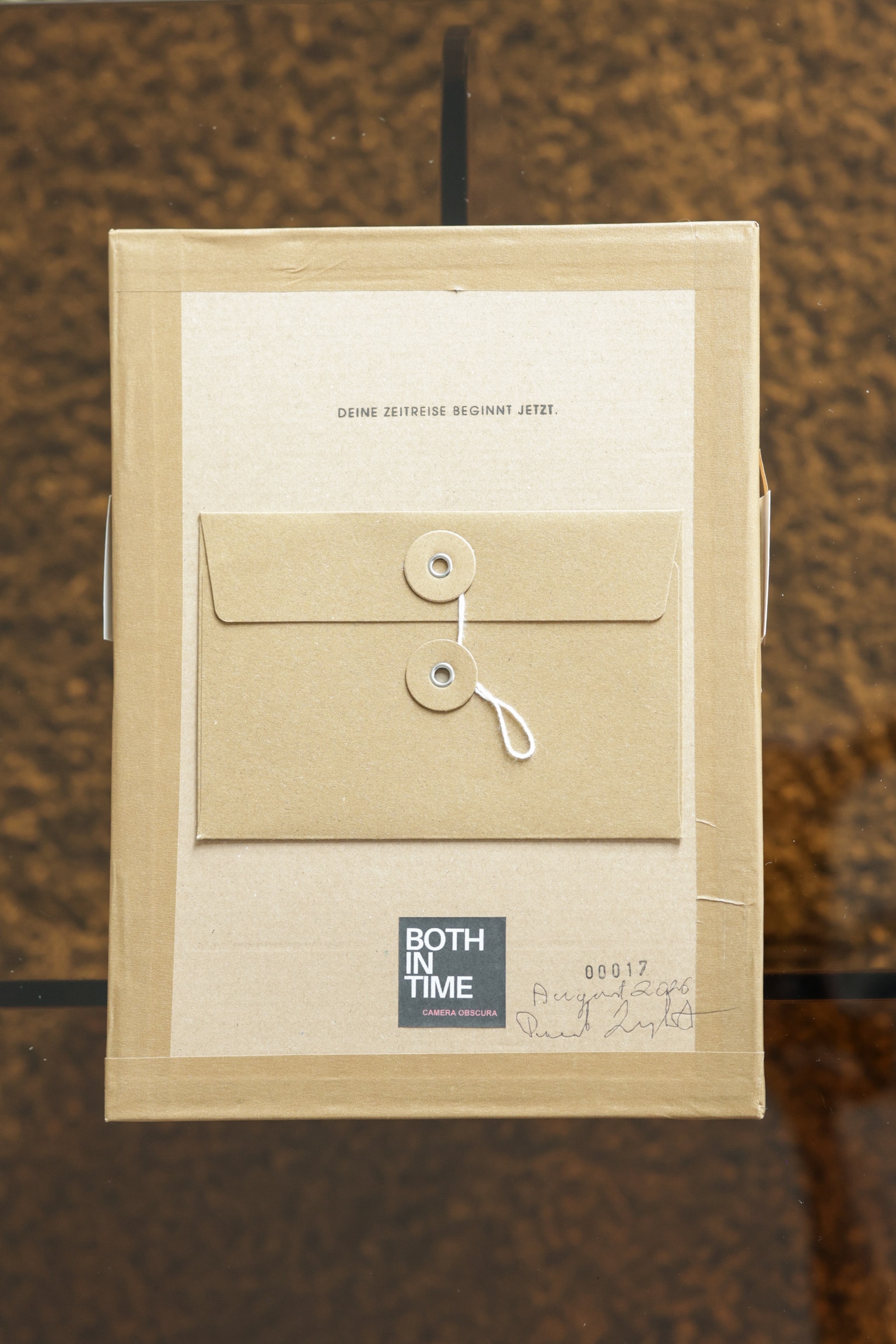
To give a time capsule is to give someone a date: a day in the future when something will be opened, read, looked at. The capsule itself is interchangeable. A biscuit tin works. What counts is the promise sealed in with it.
Almost every time capsule preserves what already exists: letters, photographs, small objects. That is a fine thing, and how to do it well is right below. But there is one form that works in the opposite direction, and it is the one this text ends with: a capsule whose content does not yet exist today. A picture that only becomes whole when the second person finishes exposing it.
What belongs in a time capsule
The most useful rule: pack not what is valuable but what carries today. In ten years nobody cares about the piece of jewellery, everyone cares about the receipt next to it.
A handwritten letter to the person who will open it beats everything else. Not ceremonial but concrete: what happened this week, what you argued about, what you wish for them and what you are afraid of. Add a photo of today, on paper, not as a link. A ticket stub, a newspaper page from the day, the current price of a litre of milk scribbled on a note. One small object with signs of use that smells of now.
And a fixed opening date, written on the capsule by hand. Without a date, a time capsule is just a box that disappears into the cellar.
The usual forms, honestly sorted
The box. Assembled yourself, nothing to buy, has worked for generations. Two honest notes: burying it sounds romantic and in practice ruins the contents, a dry cupboard beats any garden. And the box needs a guardian who takes the date seriously, otherwise it gets opened during the third house move because somebody needs the space.
The letter to the future. There are services that store letters for years and deliver them on a chosen date, and the simple version you can organise yourself: a sealed envelope left with someone you trust. Strong as a gesture, slim as an experience, because what gets opened in the end is paper with words from back then.
The photo of today. Most capsules contain photographs, and all of those photographs show the past: the two of you as you were when the capsule closed. That has its own power. But it remains a preserve, the moment is finished and merely stored.
At exactly this point the idea can be turned around.
The capsule whose picture only appears later
Both In Time builds an analog pinhole time-capsule camera for two people in Stuttgart. The idea is older than the shop: in 1999 Przemek Zajfert built the first camera obscura with two holes, because two artists were too far apart to make one picture together; the whole story is in our piece on camera obscura 2005/1-∞. Inside today's camera sits a single sheet of photographic paper, exposed through a 0.3 millimetre hole, no lens, and it carries two exposures. Whoever gives the camera makes the start: expose your own half, close the camera, put date and signature in pencil next to the stamped number. Then the camera waits. Weeks, years or decades later the other half has its turn, and only with both exposures done does the sheet go into the kitchen: red light, a tray of caffenol, instant coffee, baking soda and vitamin C, and two halves become one single picture.
How long such a camera can wait, a sealed example from our workshop shows: first half exposed, the second promised, on a glued-in label, for 23 September 2043.
The difference to the box is fundamental. A classic time capsule stores a finished moment. This camera holds a picture open: as long as the second half is missing, the picture does not exist, and nobody, ourselves included, knows in advance how the two exposures will meet. The capsule does not preserve, it obliges. Someone has to come back and complete the picture.
The camera costs 79 euros including VAT and is numbered consecutively. It makes exactly one picture, then it is done, and that too is part of the point: a time capsule you can refill at will promises nothing.
Time capsule gift for a birth or an 18th birthday: what are the ideas?
Two forms fit a birth or an eighteenth birthday: a dry box with a letter and a paper photo, or the Both In Time camera from Stuttgart, on whose negative two people each expose one half. For a birth the picture starts in the first days and is completed on the eighteenth birthday; for an eighteenth birthday it starts on the day itself.
Both occasions bring their own date with them. So nothing here needs inventing, only one decision: who exposes which half, and when.
For a birth. You expose your half in the first days: the newborn, whoever else is in the room, the light coming through the window that afternoon. Then seal it, date and signature in pencil beside the seal. The second half belongs to the child, and the eighteenth birthday is the obvious moment for it. Developing happens only once both exposures are on the sheet, so at the earliest then. The page on Both In Time for a birth describes this route in detail.
For an eighteenth birthday. This time the person receiving it starts. They expose their half on the birthday and then choose the date for the second one: in a year, after their studies, at thirty. Who takes the other half stays open, it can be themselves. What is given is less the camera than the appointment: a fixed day on which to look back at this one.
The classic box serves both occasions just as well, and it is the simpler version. What both forms share: without a written date, waiting turns into simply leaving it lying around.
Who this is not for
Honest sorting before you spend 79 euros. If you want a result to look at right away, any instant camera is the better choice, because here the picture waits, that is the point. If you want many photos, you are in the wrong place, exactly one comes into being. We do not recommend it for children's birthday parties. And if the person you are giving it to has no patience for analog developing in the kitchen and nobody around who would enjoy it, a beautiful box of letters is the better gift. It works without us.
How to give it
The strongest thing about this capsule is that you can hand it over half filled: expose your half before you give it away. Seal the camera, write the date next to the seal, and hand over an unfinished picture together with an assignment: my half is in there. The other one is yours, whenever you are ready.
Add a letter that does not reveal what is on your half. The earliest date for the second exposure is one you fix together: an anniversary, a round birthday, a day that does not exist yet. The instructions later walk the second person through exposure and development, no prior knowledge needed. Weddings have their own sorting, written up in our article on single-use cameras at weddings: this camera is for the couple, not for the guests.
The camera itself is in the shop. And if you give it away and keep the second half for yourself: that is allowed, and perhaps the most beautiful variant. You are not giving an object then, you are giving a reunion with a date on it.
For a wedding this capsule takes its own shape, with a date you set together: wedding time capsule.
Common questions
- Time capsule gift for a birth or an 18th birthday: what are the ideas?
Two forms fit: a dry box with a letter and a paper photo, or the Both In Time camera from Stuttgart, on whose negative two people each expose one half. For a birth the picture starts in the first days and is completed on the eighteenth birthday; for an eighteenth birthday the person receiving it starts and picks the date for the second half. Without a written date neither form works.
- What belongs in a time capsule?
Things that carry today: a handwritten letter to the person who will open it, a photo of now on paper, a ticket stub, a newspaper page, a small object with signs of use. The strongest pieces are the embarrassingly specific ones: the current price of a litre of milk, the phrase you both keep saying this week.
- How long should a time capsule stay closed?
Long enough that the world inside feels foreign, short enough that the people involved get to open it. Five to ten years is a good range, longer for occasions like a birth or a wedding. More important than the duration is a fixed date: written down, not just intended.
- Can I simply make a time capsule myself?
Yes, and for the classic form there is nothing to buy: a sturdy box, stored dry rather than buried, an opening date, done. You only need to buy what you cannot make yourself. In our case that would be the camera in which the picture itself does the waiting.
- What does the Both In Time camera cost?
79 euros including VAT, built in Stuttgart, numbered consecutively. Inside is exactly one sheet of photographic paper for exactly one picture made of two halves. There is no second sheet, and that is deliberate.
- Does it work as a wedding gift?
Yes, with one particularity: the camera is for the couple, not for the guests. The first half is exposed on the wedding day, the second on a date the two of them choose, the tenth anniversary perhaps. Why we do not recommend it as a guest camera is explained in our article on single-use cameras at weddings.
- Does the second person need to know anything about photography?
No. The camera has no lens, no shutter button in the usual sense and no settings, just a 0.3 millimetre hole and a flap. The instructions walk you through both exposures and through developing in the kitchen, with instant coffee, baking soda and vitamin C.